Arc Line
The line used to draw a dash can be specified with ~ instead of -.
In this case, the curve is a quadratic Bézier curve.
Now, let's explain the case of a left curve.
That is, the case ~[l:<t>]>.
Let the differences between the starting point z_{0} and the ending point z_{1} in the x and y directions be d_{x} and d_{y}, respectively.
Then, the point z_{2} is located t*d_{y} units in the x-direction and -t*d_{x} units in the y-direction from the midpoint z_{m}.
Draw a Bézier curve that internally divides the three points found so far, z_{0,1,2}, as control points in a 1:1 ratio.
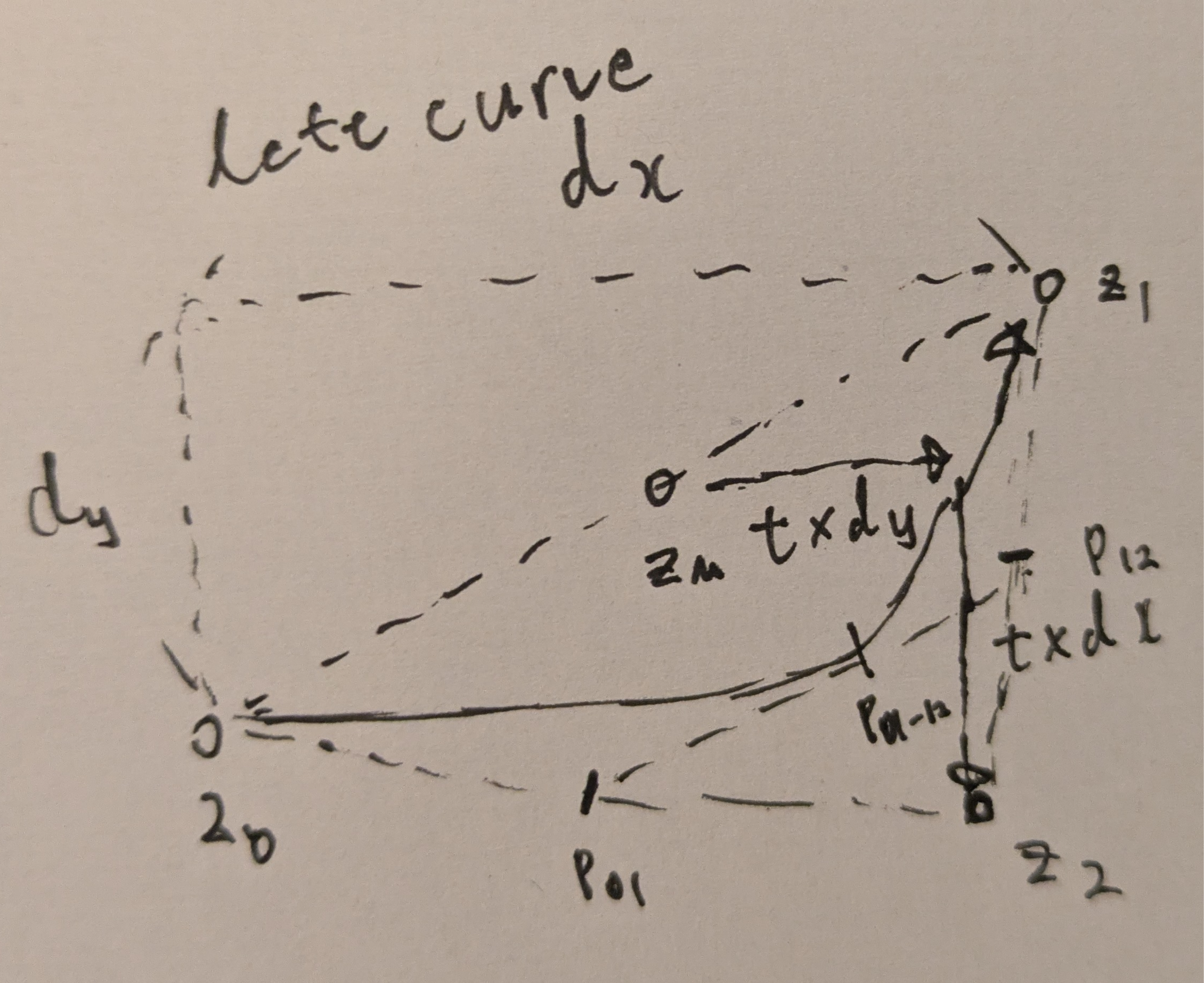
Therefore, the larger the value of t, the larger the arc it describes.
players = {p1, p2, p3, p4, p5}

state = {
  position = {
    p1 = (60, 0),
    p2 = (30, 0),
    p3 = (0, 0),
    p4 = (-30, 0),
    p5 = (-60, 0),
  }
}

action = {
  move = {
    p1 ~[l:0.1]> (60, 60),
    p2 ~[l:0.2]> (30, 60),
    p3 ~[l:0.3]> (0, 60),
    p4 ~[l:0.4]> (-30, 60),
    p5 ~[l:0.5]> (-60, 60),
  }
}